
A multidisciplinary group of researchers are conducting case studies of the implications for global information, communication, and security rising from the Russia-Ukraine War, particularly since Russia’s full-scale invasion of 24 February 2022. The focus is on the informational and communicative implications related to influence operations and propaganda in this ongoing war but also in shaping what could be a longer-term global crisis of trust in public information, communication, and security practices and policies.[2] Our work involves a case study of the war but also embedded case studies of specific aspects, including our first study of how the Ukraine public accesses trusted information about politics and the progress of the war.
Our early study of how the people of Ukraine get access to trusted information was supported by UNESCO and the People of Japan. See: https://papers.ssrn.com/sol3/papers.cfm?abstract_id=5311707


Further studies will explore a broad array of issues. There are countervailing viewpoints on developments surrounding the information war tied to Russia’s invasion of Ukraine and its long-term global consequences. Are actions largely a reflection of similar events overtime and in other parts of the world? Alternatively, is the present crisis qualitatively more consequential and in significantly new ways – a virtual techno-apocalypse for global information, communication, and security? Alternatively, are there major aspects of both continuity and change in the unfolding developments of this war?
The development of case studies is based on an assumption that aspects of this war could be transformative – what might be a game changer. Trust, reliance, and the security of media, information, and communication technologies, such as the internet and social media, could be undermined not only in the Russia-Ukraine conflict zone but across the world. Some have even characterised this as the ‘first world war’ in that it is being followed and engaged by nations across the entire world through new media and communication facilities. Based on its multiple dimensions, the research team is conducting an overarching case study of the broad range of developments around influence, networks, and security being shaped by the Russia-Ukraine War, broadly defined. In addition, the team is conducting a developing set of embedded case studies of particular developments within Russia, Ukraine, and internationally, such as in relation to public and private geopolitical allies and adversaries across the world.[3]
The Multidisciplinary Research Team
The research team is international, including university faculty, Oxford DPhil students, early and late-career researchers, and links across the university and the globe to experts in areas of central importance to this study. We have key research staff supporting the conduct of in-depth interviews and the synthesis of documents in Ukrainian, Russian, Belarusian, German, and other languages. The evolving team includes:
Researchers
William H. Dutton, Martin Fellow at the Oxford Martin School, supporting the Global Cybersecurity Capacity Centre (GCSCC), also a Senior Oxford Internet Institute (OII) Fellow, University of Oxford, and Director of The Portulans Institute, Washington D.C.
Lisa Chernenko is a DPhil candidate at the Oxford Internet Institute and Associate Researcher at the Portulans Institute. Lisa’s research explores strategies to counteract dehumanisation in online communication, specifically focusing on the phenomenon of re-humanisation. In the aftermath of Russia’s 2022 invasion of Ukraine, she examines linguistic facets of outgroup dehumanisation and mechanics of re-humanisation in relation to Ukrainians and Russians across digital platforms.
Collaborations
We are collaborating with researchers anchored in other organisations, such as Dr. Anna Mysyshyn, Co-founder of the Institute for Innovative Governance (IIG). Dr. Mysyshyn is an expert in AI, cybersecurity, and digital governance, with over a decade of international experience advising governments on legal and ethical technology policy. She works with the UK Foreign, Commonwealth & Development Office, the U.S. Department of State, NATO, and the Argentina Ministry of Defence on AI regulation, FIMI threats, and national security.

Research Associates (involved in selected cases)
Other research associates include:
Courtney Bower, a Ph.D. candidate in regional science at Cornell University, a Senior Fellow at the Portulans Institute and former Peace Corps Volunteer in western Ukraine. Courtney’s research examines technological resilience and regional innovation systems. His related research focuses on the circular economy, post-war reconstruction, infrastructure policy, and Black Sea spatial imaginaries.
Mykyta Petik, GCSCC Researcher, and Doctoral Student in Law, KU Leuven, Belgium, with a Master of IT Law at Tartu University and a Master of EU Law at Ghent University.
Project Advisors
Niva Elkin-Koren, Professor of Law at Tel Aviv University Faculty of Law, former Dean of the Faculty of Law at the University of Haifa, and was founding director of the Center for Cyber, Law and Policy (CCLP), and the Haifa Center for Law & Technology (HCLT)
Professor Sadie Creese, Director of the GCSCC, and Professor of Computer Science in the Department of Computer Science, Oxford University
Professor Soumitra Dutta, Co-Founder and President of Portulans Institute and Peter Moores Dean and Professor of Management in the Saïd Business School at the University of Oxford
Studies Underway and in Development
A basic foundational case study will be as broad as necessary, initially including study of developments across five interrelated areas critical to local and global information, communication, and security: influence operations, public reception, international networking, cybersecurity, and innovation and R&D. All of these areas are clearly interrelated, suggestive of an ecology of nested games (Crozier and Friedberg 1977; Dutton 1992), but also each can provide a unique focus of inquiry.
Influence Operations concern the development and communication of narratives, such as propaganda defining the aggressor as the defender or the victim, using the concept of a ‘special military operation’ versus a war, or even redefining national boundaries.
Public Reception, including opposition, rejection, or resistance to competing narratives, focuses on whether and how the attitudes or beliefs of different sectors of the public are reshaped as a consequence of different information operations, such as various forms of propaganda.
International Networking concerns how Ukraine and Russia have enrolled international support in public arenas, such as the UN, and in trade and the supply of arms. How have international alliances and neutral actors been aligned overtime and with what effect?
Security is principally concerned with cybersecurity of information and infrastructures, such as surveillance, data collection, disruption of critical infrastructures, and hacking, but also in relation to related dimensions of security such as in cognitive warfare being linked to kinetic warfare.
Innovation and R&D cross-cuts all of the other areas in addressing whether this war is leading to new developments and investments in particular areas, from security to information warfare, for better or worse. And all of these areas present major research challenges, such as in useful theoretical frameworks and the development of reliable and valid data about public attitudes, beliefs, and opinions.
These areas are being refined overtime, but each has been central to early geopolitical processes underway around the conflict in this evolving geopolitical techno-sphere of conflict. While these areas are closely related, they have been separated because they can be tied to different areas of research and expertise. The study of influence, for example, is a key topic in political communication. The use of radio for propaganda in World War II was a major impetus for the development of media studies in the US and Europe. It could well be that the influence operations in Russia will become a similar driving force in returning to, and up-dating, the study of propaganda and influence for the digital age.
The study of public reception, rejection, and resistance to narratives of different states, adversaries, and other actors is related to political communication and closely linked to the study of influence. Prominent political communication theories, such as the two-step flow of communication and the spiral of silence, could be valuable to the case.
The study of international networks is global and the topic of many, if not most, news and public affairs treatments of the crisis, but it can gain from a variety of other methods and theories that could be used in this area, such as more systematic network analyses.

Finally, cybersecurity is central to developments. The Prime Minister of Estonia aptly claimed that Ukraine is a “masterclass on cyber-defence” (Kallas 2023). And cybersecurity is tied to all the other areas of study as it entails the propagation of disinformation, the use of digital media for surveillance and collection of data about the public and military, and the use of hacking and cyber-attacks to disrupt nationally critical infrastructures and services, including local and international information and communication networks. The expertise required in this area includes backgrounds in cybersecurity policies and practices that seek to address these issues, such as education and awareness campaigns, the development of cyber expertise, and cybersecurity capacity building (Creese et al 2021).
Early studies of Russia’s War in Ukraine have been most often focused on particular issues, such as implications for internet fragmentation. While valuable in their own right and for contributing to the present study, these specifically focused studies risk losing site of the big picture – how the individual aspects of this crisis are interrelated with implications beyond any specific area. Our broad case study approach seeks to capture the overall patterns and themes emerging across these key areas. As particular areas, such as cybersecurity rise in significance, the study can be opened to additional embedded case studies, or even more focused and more embedded studies of particular areas.
The Case Study Approach
Case studies are a major approach for research on policy and practice particularly in areas that are new or not well developed nor heavily researched. They enable researchers to discover patterns and themes that enhance understanding of otherwise less coherent or disconnected events and actions. Case study research is well developed and covered by major works such as Robert Yin (2017) and Paul Diesing (2008). Embedded case studies focus on an identifiable part of a larger case study but follow the broad methodological approaches of case study research in general (Scholz and Tietje 2001).
Limitations of our Case Studies
A case study cannot prove a theory or confirm a hypothesis. A case is unique, by definition – a particular case. However, it can be a means for discovering patterns and themes that could be sufficiently descriptive or explanatory that they can support actions, such as policy or practices to address this area or a similar area, such as a subsequent conflict. And case studies can be richly suggestive of theoretical concepts or other research that can be further pursued, such as our focus on ‘cognitive politics’.
One of the features of systematic and in-depth case study research is that the findings are rarely a simple confirmation of initial expectations. As we learn more about a case, the patterns and themes often lead to new insights and discoveries that become suggestive of theory and concepts that can be further explored by additional research and critical debate.
Status of the Ukraine Case Studies
The Ukraine case studies are in varied stages of development through working papers, the organisation of roundtable discussions, and the funding for a survey of the public in Ukraine. The roundtables were designed to help launch the case research but also to refine our approach, illuminate key research questions, and identify potential ties with researchers in other universities and institutions.
Roundtable Discussions
The project was initiated by discussions at HIIG in Berlin in June of 2022, immediately after the full-scale invasion of Ukraine. The first roundtable discussion was held at HIIG in Berlin in June 2023. Entitled, “Is the Invasion of Ukraine Reshaping ICT, R&D, and Cognitive Warfare?”, the workshop led to a range of questions that were pursued in later roundtables and research.
The second roundtable was held at the Saïd Business School at Oxford University on 26 September 2023. Entitled ‘Reshaping Global Information, Communication, and Security: The Russo-Ukraine War’, the roundtable engaged thirty-five participants in a hybrid format. A brief synopsis of the second roundtable is posted here.
Our third event, held on 26 January 2024, was an Oxford Research Forum for early career researchers, held at the Oxford Internet Institute. This third forum focused on the implications of the Russia-Ukraine War (RUW) for information, communication, innovation, and cybersecurity. There is a summary of the forum on the Portulans website, and on this blog. The forum brought together a diverse mix of early career researchers from 12 universities representing 8 countries.
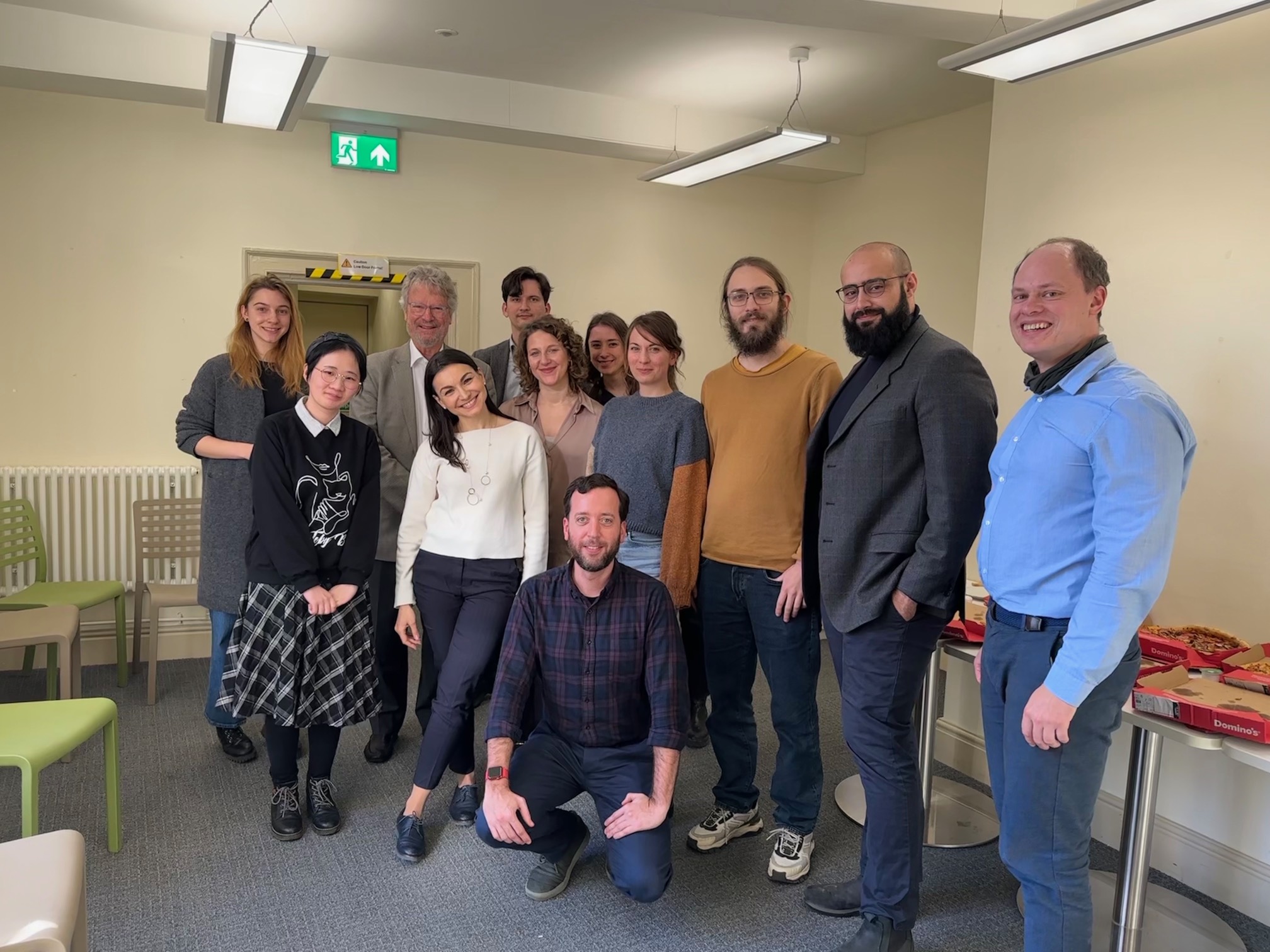
Further forums and presentations have since been held in Ukraine and will continue to develop as a means to test and refine our developing themes and concepts gained from the case studies.
Working Papers and Publications
Axon, L., Saunders, J., Esteve-González, P., Carver, J., Dutton, W., Goldsmith, M., & Creese, S. (05 Feb 2025): Private-public initiatives for cybersecurity: the case of Ukraine, Journal of Cyber Policy, 5 February: DOI:10.1080/23738871.2025.2451256: Online at: https://doi.org/10.1080/23738871.2025.2451256
Blank, G., Boiko, N., Chernenko, E., Dembitsky, S., Dutton, W., Goroshko, O. (2025), Political communication in wartime Ukraine. Paper presented at the 5th International Sociological Association Forum, 10 July in Rabat, Morocco.
Boiko, N. (2024), ‘Media Consumption and the Balance of Trust in Different Information Sources: Expectations vs. Reality’, pp. 133–136 in L. Kalashnikova (ed.), Information Society and Nature: Vectors of Mutual Influence. Collection of materials of the VIII International Scientific and Practical Conference (Kryvyi Rih, November 21–22, 2024) Kyiv: Karavela.
Boiko, N. (2025). ‘Trust in different sources of information in wartime: a sociological analysis of the Ukrainian experience’, Sociology: Theory, Methods, Marketing, 2, 59-79, https://doi.org/10.15407/sociology2025.02.5.
Boiko, N. (2024), ‘Trust in traditional media, Internet information and other sources in wartime’, in materials of the XXI International Scientific and Practical Conference “Problems of sociological theory development: Military challenges, social reactions and conceptual reflections”, 6 December in Kyiv, edited by Dr. Sociology Lyudmila Males, Dr. Sociology Yuriy Saveliyev, Ph.D. Olha Ivashchenko, Ph.D. Olena Vilkova, Taras Shevchenko National University of Kyiv, Faculty of Sociology: “Scientific Capital”, 2025. – pp. 20-24. Available at: https://www.sociology.knu.ua/sites/default/files/newsfiles/2024_issues_in_the_development_of_sociological_theory_proceedings.pdf)
Chernenko, Lisa and Dutton, William H. (2025), ‘Who Trusts Telegram? The Dynamics of Trust and Use of Social Media in Wartime Ukraine’, Ukraine Case Studies Working Paper. Washington DC: Portulans Institute (March 31, 2025). Available at SSRN: https://ssrn.com/abstract=5227613 or http://dx.doi.org/10.2139/ssrn.5227613
Chernenko, Elizaveta and Dutton, William H., (2025), ‘The Role of Telegram in Wartime Ukraine: Trust, Utility, and Controversy’, Portulans Institute, Washington DC: October 26, 2025). Available at SSRN: https://ssrn.com/abstract=5669030 or http://dx.doi.org/10.2139/ssrn.5669030
Dutton, Bill (2025), ‘The War on Information in Ukraine: A Global Ecology’, pp. 62-71 in Roland A. Römhildt , ed., Reclaiming Europe: A Collection of Essays. Berlin: Young Network Trans Europe. [An earlier version online: Dutton, W. H. (2025), ‘The War on Information in Ukraine: A Global Ecology’, Ukraine Case Studies Working Paper. Washington DC: Portulans Institute. (May 14, 2025). Available at SSRN: https://papers.ssrn.com/sol3/papers.cfm?abstract_id=5254417]
Dutton, William H. with Lisa Chernenko and Mykyta Petik (in progress), ‘Russia’s Hybrid Information War on Ukraine: An Ecology of Games’, Working Paper in Progress, Portulans Institute and GCSCC, University of Oxford.
Dutton, William H. and Blank, Grant, ‘The War on Trust in Public Officials and the Media of Ukraine’, Ukraine Studies Working Paper. Washington DC: Portulans Institute. (March 31, 2025). Available at SSRN: https://ssrn.com/abstract=5202222 or http://dx.doi.org/10.2139/ssrn.5202222
Dutton, W. H. and Blank, G. (2025 forthcoming), ‘Liberal Democratic Crises over Digital Media have been Eclipsed by Russia’s War on Information’, chapter 9 in S, Coleman, F. Esser, J. Firmstone, K. Parry, and C. Paterson, eds., Public Communication in Free Fall, London: Palgrave.
Dutton, W.H., Goroshko, O., Dembitskyi, S., Chernenko, L., Blank, G., and Boiko, N. (2025), ‘Trust in Media, Information, and the Government in Ukraine: A Virtuous Circle of Challenges’, paper delivered at the 2025 Meeting of the World Internet Project, Berlin, Germany, 7 July. Available at: https://papers.ssrn.com/sol3/papers.cfm?abstract_id=5311707
Goroshko, O., Dutton, W. H., Dembitskyi, S., Chernenko, L., Boiko, N., and Blank, G. (2024), Media Use and Attitudes in Ukraine: A Smart Nation, The Portulans Institute, Washington D.C. Available at SSRN: https://ssrn.com/abstract=4958986 or http://dx.doi.org/10.2139/ssrn.495898
Blogs and Short Notes
Dutton, W. H., and Chernenko, L. (2024), ‘Telegram: A Platform of Value to the People of Ukraine’, blog posted on WordPress and Substack, 29 August. https://billdutton.me/2024/08/29/telegram-a-valuable-platform-to-the-people-of-ukraine/
Calling a War a War: https://billdutton.me/2024/05/09/calling-a-war-a-war/
Hurrah! Bringing Hope Back to Ukraine: https://billdutton.me/2024/04/22/hurrah-bringing-hope-back-to-ukraine/
Time is Running Out for the US: https://billdutton.me/2024/04/12/time-is-running-out-for-the-us/
Putin’s Showcase for Authoritarian Democracy: https://billdutton.me/2024/03/21/putins-showcase-for-authoritarian-democracy/
Information is Powerful: Research on Ukraine: https://billdutton.me/2024/02/24/information-is-powerful-research-on-ukraine/
Democracy versus Autocracy: https://billdutton.me/2024/02/14/democracy-versus-autocracy-personal-reflections/
Why Swallow Propaganda: You Believe What You Want to Believe: https://billdutton.me/2024/01/21/why-swallow-propaganda-you-believe-what-you-want-to-believe/
Cognitive Politics: https://billdutton.me/2023/08/03/cognitive-politics/
Change and Continuity in War Propaganda: https://billdutton.me/2023/10/30/change-and-continuity-in-war-propaganda/
The Symbolic Politics of Labelling Russia’s Invasion of Ukraine: https://billdutton.me/2023/09/08/the-symbolic-politics-of-labelling-russias-invasion-of-ukraine/
Timeline of the Russo-Ukraine War (RUW): Case Study: https://billdutton.me/2023/10/06/timeline-of-key-moments-in-the-russia-ukraine-war-ruw-case-study/
Support for this Project
Initial support for this project has been provided by the Portulans Institute, which complements support from researchers in Oxford’s Global Cyber Security Capacity Centre (GCSCC), the Saïd Business School, and the Oxford Internet Institute (OII) in collaboration with researchers at the Alexander von Humboldt Institute for Internet and Society (HIIG). The Portulans Institute, an independent, nonprofit, nonpartisan research and educational institute based in Washington D.C. This project aims to contribute to development of work at the Portulans Institute on the societal issues of global information and communication networking, and its research in creating longitudinal data on global networking, such as the Network Readiness Index (NRI).
Support for research on public reception was provided from 2024-25 by UNESCO and The People of Japan, primarily for our survey of the people of Ukraine.
References
Creese, S., Dutton, W. H., Esteve-Gonzáleza, P., and Shillair, R. (2021), ‘Cybersecurity Capacity Building: Cross-National Benefits and International Divides’, Journal of Cyber Policy, 6(2), 214-235. Available at: https://www.tandfonline.com/doi/full/10.1080/23738871.2021.1979617
Crozier, M., and Friedberg, E. (1977), Actors & Systems: The Politics of Collective Action. Chicago: University of Chicago Press.
Diesing, Paul. (2008), Patterns of Discovery in the Social Sciences. London: Routledge.
Dutton, W. H. (1992), ‘The Ecology of Games Shaping Telecommunications Policy,’ Communication Theory, 2 (4), 303-28.
Dutton, William H. (2023), ‘Geopolitical Realities Emerging from the Russian Invasion of Ukraine: Undermining the Foundations of Globally Networked Societies’, Working Paper in Progress, GCSCC, University of Oxford.
Kallas, Kaja (2023), ‘Kaja Kallas says Ukraine is giving the free world a masterclass on cyber-defence’, The Economist, 17 April.
Scholz, Roland W., and Tietje, Olaf (2001) (eds), Embedded Case Study Methods: Integrating Quantitative and Qualitative Knowledge, 1st Edition. Thousand Oaks, CA: SAGE Publications, Inc.
Yin, Robert (2017), Case Study Research and Applications: Design and Methods, 6th Edition. Thousand Oaks, CA: Sage.
Zhora, Victor. (2023), Cyber Operations in Ukraine. Presentation on cyber operations in Ukraine at the Royal United Services Institute (RUSI), 25 April.