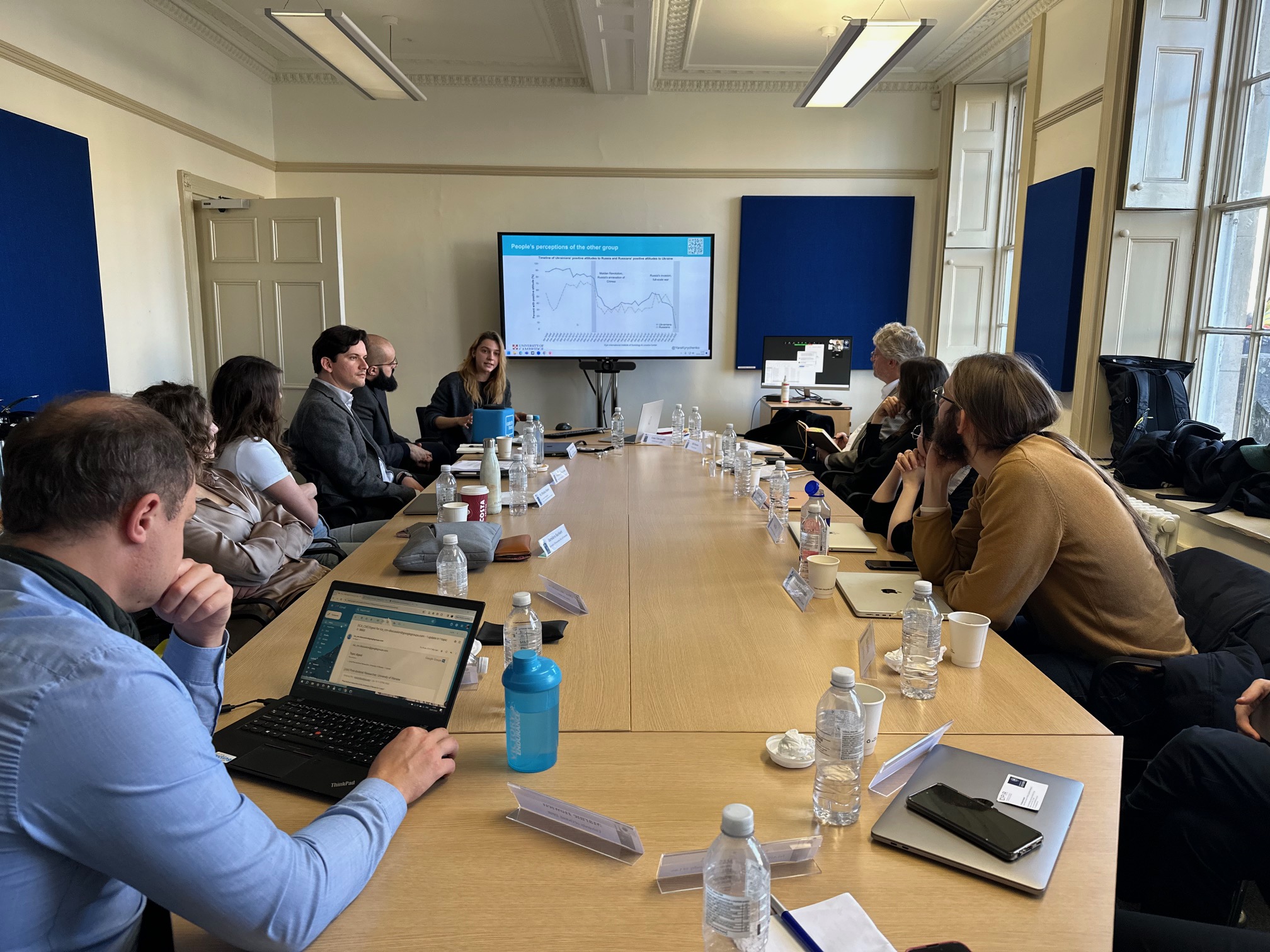
The Portulans Institute supported the conduct of an Oxford Forum on ‘The Implications of the Russian War in Ukraine for Global Information, Communication, and Cybersecurity’, which was held on 26 January 2024 in a Board Room of the Oxford Internet Institute (OII). It was conceived, organized, and chaired by an OII DPhil Candidate, Elizaveta (Lisa) Chernenko, also a Portulans’ researcher.
This forum followed two previous Portulans’ roundtables on the informational and communicative fronts of the Ukraine-Russia War. In helping with the organisation of the second roundtable at Oxford University, Lisa Chernenko discovered a surprising number of doctoral students, doctoral candidates, and other early career researchers who were conducting their own research on topics of great relevance to our roundtables. This led Lisa to suggest putting together a forum for these early career researchers, which my colleagues and I quickly supported. Lisa shepherded this from its conception through the conduct of the forum, from selecting presentations to chairing the day and even ordering the pizza and keeping time for the presenters, while also presenting her own research.
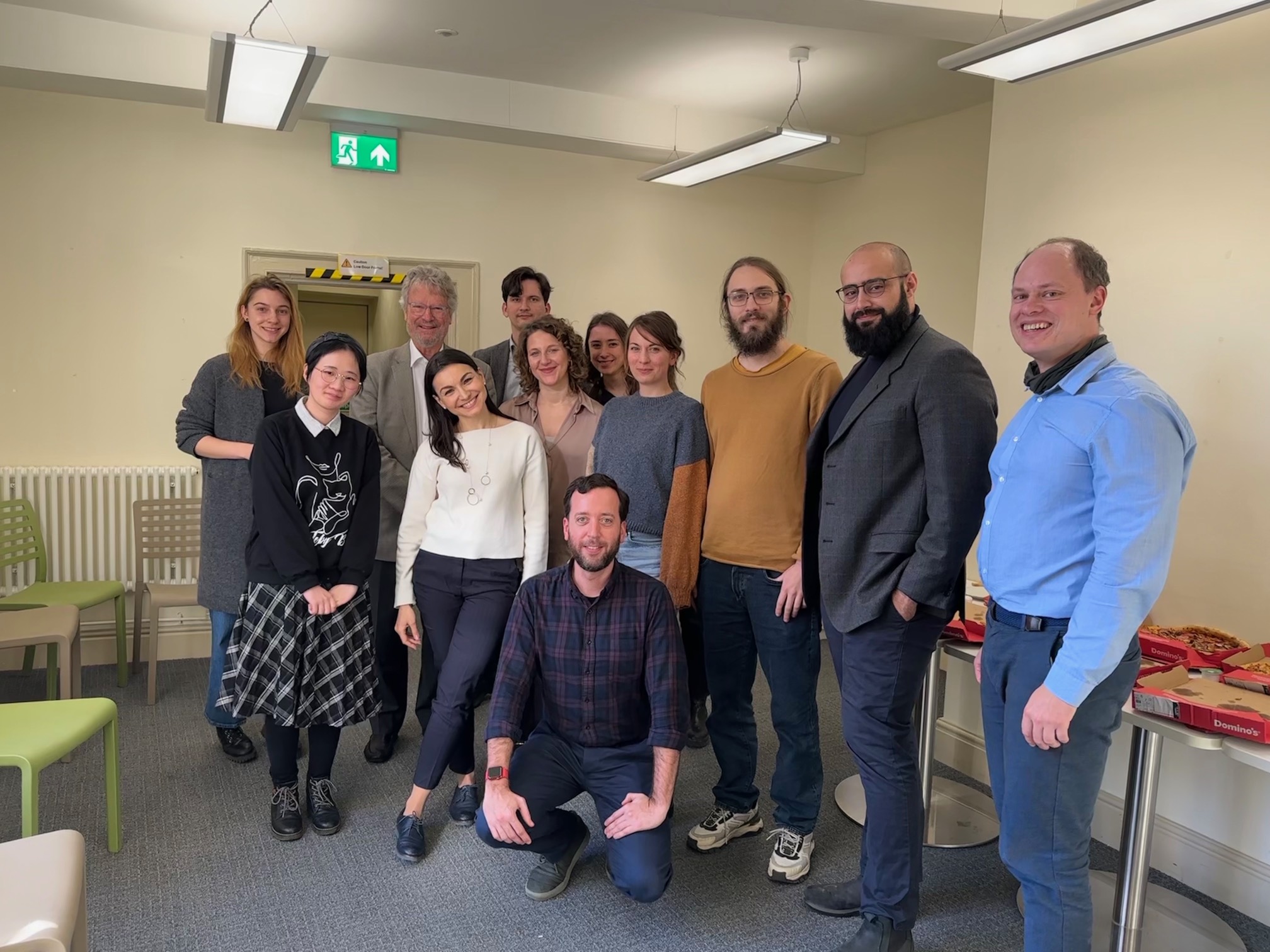
The OII room available for the forum could only accommodate 16 people, and those slots were rapidly filled with promising proposals from early career researchers from eight countries, including: the UK (University of Oxford, University of Cambridge, Univeristy of Birmingham, University of Essex); Ireland (University of Dublin); Israel (Tel Aviv University); Finland (University of Helsinki, Aalto University); Netherlands (University of Amsterdam); Italy (European University Institute); Denmark (University of Copenhagen); and Belgium (KU Leuven), including a number of Ukrainians studying at Oxford and other participating universities. Given the limitations on personal participation, the OII enabled us to use their video conferencing systems for organising this as a hybrid event, permitting others to view presentations of interest.
The presentations included topics on:
Propaganda, Narratives, and Diplomacy
Jaroslava Barbieri, ‘Captiv(at)e hearts and minds: A study on the evolution of Russia and Ukraine’s information campaigns towards Russia-occupied territories (2014–2023)’
Dr Ales Herasimenka, ‘State-Backed Digital Propaganda and the Russian Invasion of Ukraine’
Alexandra Pavliuc, ‘Unpacking how gender impacts strategic narrative use in digital diplomatic efforts between Ukraine and the West during Russia’s full-scale invasion of Ukraine’
Lisa Chernenko, ‘Outgroup dehumanisation in Russian and Ukrainian Telegram – language representation and the role of ingroup identity’
Public Reception and Resistance
Dr Marnie Howlett, ‘Bunkering the Nation: The Politicization of Ukraine’s Shelters Amidst Russia’s Aggression’
Noah Buckley, ‘Mobilizing the Demobilized: Authoritarian Regime Inducements to Participation in Conflict’
Innovative Approaches to Cybersecurity and Surveillance
Dr Natalie Davidson, ‘Big Tech’s Evolving Role in Cybersecurity: Regulating Spyware in the Context of the Russia-Ukraine War’
May Har-Shai, ‘How War is Likely to Shape AI Technology?’
Shaping Social Networking
Roman Kyrychenko, ‘The Role of Telegram in the Russo-Ukrainian War: A New Propaganda Model’
Yara Kyrychenko, ‘Ingroup solidarity drives engagement on social media during intergroup conflict’
M. (Mónika) Simon, ‘Tracing information flow dynamics during the initial phase of the Russian invasion of Ukraine’
Yan Xia, ‘Did the Russian invasion of Ukraine depolarize political discussions on Finnish social media?’
Regulating Propaganda, Security, and Information
Mykyta Petik, ‘Reframing Digital Sovereignty in Ukraine Post-Russian Invasion: Legal and Policy Imperatives for the New Era’
Dr Yevgeniy Golovchenko, ‘YouTube’s Ban on Russian Propaganda Outlets’
Christiern Santos Rasmussen, ‘Blocking the Information War?’
Dr Elena Sherstoboeva, ‘Constructing Legality: Russian Courts’ Interpretation of International Law during the Ukraine Conflict’.
Acknowledgements
As the late-career researcher and co-organiser of this event, I want to express my sincere congratulations and thanks to Lisa Chernenko for leading the organisation of such a successful forum for early career researchers. The experience of the day and from immediate feedback suggested that the forum offered real value not only to the early career researchers, enabling them to network with colleagues involved in related research, but also to the wider academic community and public concerned over how to understand the implications of this war on the future of global information, communication, and technological innovation.
Most importantly, we thank all the early career researchers, including Lisa, for sharing their research in such a collegial, constructive, and friendly atmosphere. Many faced very similar challenges in obtaining data, using a wide array of analytical methods and tools, protecting personal data, and grappling with sensitive issues of a country at war. The expertise, training, and good spirit and humour, of these researchers was inspiring. They were so interested and committed that they contributed their time and, in many cases, financed their travel or raised funds from their home institutions to participate in this event. These qualities of academic collaboration are inspiring.
Finally, this forum would not have been possible without the support of key institutions, including the Chief Justice Meir Shamgar Center for Digital Law and Innovation at Tel Aviv University, the Oxford Internet Institute, Oxford’s Saïd Business School, Oxford’s Global Cyber Security Capacity Centre (GCSCC) and the Alexander von Humboldt Institute for Internet and Society (HIIG) in Berlin. All of these institutions have worked with me and Niva Elkin-Koren in developing the Ukraine Case Studies, a project leading to this forum.
Thank you for promising work on major challenges facing Ukraine.

[…] innovation, and cybersecurity. There is a summary of the forum on the Portulans website, and on this blog. The forum brought together a diverse mix of early career researchers from 12 universities […]
What a pleasure to read of such activities going on to reduce the current levels of bafflement.